

Every year in Dubai, the same question comes up. Should you keep renting, or is it time to buy? In 2026, the answer has more to do with your own timeline than with what the market is doing. Dubai closed 2025 with over 270,000 property transactions valued at AED 917 billion, a 20% increase year-on-year and the strongest performance the market has recorded (Dubai Media Office, 2026). Strong numbers. But they don't automatically make buying the right move for everyone living here.
The short answer: buying is more profitable for anyone planning to stay five years or more. The longer answer depends on your contract situation, your savings, and which part of Dubai you're in. This breakdown gives you the actual numbers.
What is Dubai's property market actually doing in 2026?
Dubai's population crossed four million residents in August 2025, with projections targeting 5.8 million by 2040 (The National, 2025). That population growth is what keeps demand real. People are moving here for work, for business licensing, for lifestyle reasons, and the infrastructure keeps following them.
Supply is worth paying attention to in 2026 though. About 120,000 new residential units are projected for handover this year, mostly in mid-tier communities (CBRE UAE Q1 2026 Review). One thing worth knowing: historical delivery rates in Dubai run at roughly 48% of what gets announced, so the actual number hitting the market will likely be lower. Prime areas remain constrained. In emerging zones, buyers and renters have more room to negotiate than they did 12 months ago.
How much does renting in Dubai actually cost in 2026?
A two-bedroom apartment in Dubai Marina at around AED 120,000 a year sounds like AED 10,000 a month. Clean and manageable. The problem is that the cost of actually getting through the door is a lot higher, and most residents underestimate it before they sign.
Most landlords still require one to four post-dated cheques, which means fronting three, six, or twelve months simultaneously. Add a 5% agency fee on the first year's rent, AED 6,000 on a AED 120,000 unit, plus security deposit, DEWA activation, Ejari registration, move-in fees, and internet setup. That's typically AED 10,000-15,000 on top of the cheques before you have keys. The first month of renting in Dubai is expensive.
The ongoing advantages are real though. No maintenance exposure, no service charges, full flexibility to relocate. For residents still figuring out which area suits them, on a fixed-term contract, or with a departure date already in mind, renting is not a mistake. It's the correct call. The problem comes when renting runs past five years with no ownership position building in a city where rents have gone up 20% or more in some areas over the past 12 months, particularly in JVC, Business Bay, and Marina (Betterhomes RERA Index Guide, 2025). Staying a long-term renter in Dubai's 2026 market has a real cost. The question is whether you're making that choice deliberately.
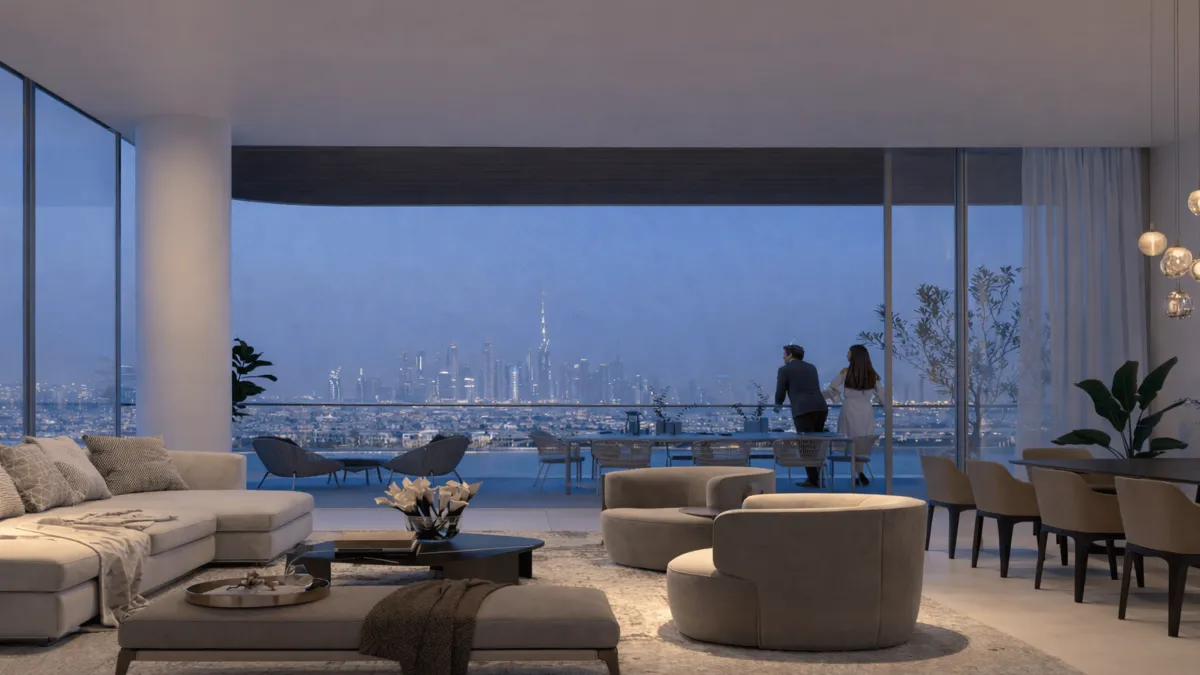
Is buying property in Dubai worth it in 2026?
For residents planning to stay five or more years, buying is almost always the more profitable position. The entry costs are real, but they're often lower than people expect relative to what they're already spending.
A two-bedroom apartment in Dubai Marina at AED 1.8 million requires a 20% down payment from a non-resident buyer (AED 360,000), plus the 4% Dubai Land Department transfer fee, 2% agency commission, and mortgage processing costs. The full breakdown of buying costs beyond the purchase price covers every fee in detail. Total entry investment typically lands at AED 400,000–450,000.
Monthly mortgage payments on that same property at roughly 4% interest over 25 years come to around AED 8,000-9,000 (Finnxstar UAE Mortgage Rates, 2026). That's comparable to, or slightly below, what the equivalent apartment rents for. Every payment builds equity in the asset rather than going to a landlord. Assuming conservative price growth of 3-4% annually, that AED 1.8 million property could reach AED 2.4 million within a decade. No capital gains tax on any of that. The break-even point, where total ownership costs fall below what you'd have spent renting, typically arrives at years 3-5 in Dubai's current market. After that, the longer you hold, the better the numbers get. Three questions that determine whether buying makes sense right now: 1. Are you staying or holding for five or more years? 2. Can you cover the down payment without touching emergency reserves or other investments? 3. Are you prepared for service charges, maintenance, and some market exposure? If the answer to all three is yes, buying makes financial sense. If any one of them is no, renting is the more rational position for now.
Short-term holiday home vs long-term let: which makes more money?
This section applies to residents who own and rent out, or are buying with the intention of renting while living elsewhere in Dubai. The rental model decision is often as financially significant as the buy/rent decision itself.
Once you own in Dubai, there's a second decision: how to rent it out. Long-term annual leasing or short-term holiday home rental under DTCM licensing. The financial profiles look similar on paper. In practice, they suit very different types of owners. Long-term letting gives you predictable cash flow, minimal management overhead, and a clean regulatory path under a standard RERA tenancy contract. Gross yields in established communities typically run 5-7%. Once a good tenant is in, you're largely hands-off. Holiday home rental can generate 20% or more above long-term let income in prime zones over a full year. But the net picture takes careful modelling. Operator fees run 15-20%, utilities are paid by the landlord, and seasonal vacancy has to be factored in. The DTCM Holiday Home licence requires a valid D permit, and running without it carries real compliance risk. Understanding what [high-end tenants actually want ](https://mavrixproperties.ae/blogs/dubai-luxury-rental-market-what-high-end-tenants-want) matters as much as the licence when positioning a premium asset. The 2026 holiday home market isn't uniformly strong. July and September see elevated vacancy as summer temperatures drop tourist numbers. The October to January window is the tightest. Performance comes down to location, OTA platform positioning, pricing strategy, and operator quality, not ownership alone.
Short-term holiday home vs long-term let
Investors who buy in Dubai face a second decision that is just as important as the first: how to position the asset for rental income. The two primary models are long-term annual leasing and Short-Term Holiday Home rental under the DTCM licensing framework. Each has a distinct return profile.
Long-term letting offers predictable cash flow, low management overhead, and a straightforward regulatory path under the standard RERA tenancy contract. Annual yields in established communities typically run at 5 to 7% gross. The landlord is largely hands-off once a good tenant is in place.
Holiday Home rental can generate significantly higher gross revenue, with well-positioned assets in prime zones exceeding long-term rental income by 20% or more over the course of a year. But the net picture requires careful modelling. Operator fees typically run at 15 to 20%, utilities are borne by the landlord, and seasonal vacancy must be factored in. The DTCM Holiday Home requires a valid D permit and licensed operators and investors running properties without this exposure carry significant compliance risk.
The 2026 Holiday Home market is not uniformly lucrative. July and September tend to see elevated vacancy as temperatures limit tourist activity. October through early January represents the tightest demand window. Performance will be determined by location quality, OTA platform positioning, pricing strategy, and the calibre of operator management not by ownership alone.
| Factor | Short-Term Holiday Home | Long-Term Let |
|---|---|---|
| Gross Revenue Potential | Higher, 20%+ above LTL in prime zones | Stable and predictable |
| Net Yield After Costs | Comparable to LTL when modelled correctly | Typically 5 to 7% gross |
| Management Complexity | Higher, D permit, DTCM compliance required | Lower, annual contract |
| Vacancy Exposure | Seasonal (model 12% average for 2026) | Minimal with a qualified tenant |
| Utility Costs | Borne by landlord | Borne by tenant |
| Regulatory Requirement | DTCM Holiday Home licence (D permit) | RERA tenancy contract |
| Best Suited For | Prime areas, high-demand tourist zones | Established communities, stable demand |

Mavrix connects Dubai property investors with vetted Holiday Home operators and property management companies. For investors who want the yield advantage of short-term rental without carrying the operational weight, Mavrix bridges acquisition to performance. View available investment properties.
Where Dubai Rental Yields Are Strongest: Location Guide for 2026 Investors
Yield is not a market-wide number. It varies by community, asset type, and even building age. Understanding the micromarket is what separates an 8% return from a 5.5% return on paper-similar assets.
Jumeirah Village Circle
JVC remains one of the highest-yield communities in Dubai for buy-to-let investors. Studio units average around 7.87% gross yield, with one-bedroom apartments at approximately 7.04%. Average sale prices sit at around AED 1.2 million, making it an accessible entry point with strong OTA demand for short-term lets.
Dubai Marina and Business Bay
These remain core allocations for investors prioritising resale liquidity and tenant quality. Gross yields typically run at 5 to 7%, lower than emerging zones but with far more predictable cash flow, established infrastructure, and superior long-term capital appreciation prospects.
Where are Dubai's rental yields strongest in 2026?
Gross yield is not a market-wide number. It shifts significantly by community, unit type, and building age. The difference between an 8% return and a 5.5% return on two similar-looking apartments often comes down to the specific building and what floor you're on.
Jumeirah Village Circle
JVC is one of Dubai's highest-yield communities for buy-to-let right now. Studio units average around 7.87% gross yield, with one-bedroom apartments at approximately 7.04% (market estimate, consistent with Bayut Annual Report 2025). Average sale prices sit around AED 1.2 million, which makes it an accessible entry point with solid OTA demand for short-term rentals.
Dubai Marina and Business Bay
These are the go-to zones for residents who want both rental income and resale liquidity. Gross yields typically run 5-7%, lower than emerging areas but with more predictable cash flow, better infrastructure, and stronger long-term appreciation prospects. If you're buying to live in and rent out later, Marina and Business Bay tend to hold their value.
Dubai South and infrastructure-linked zones
Areas along the Dubai Metro Blue Line, including Dubai Creek Harbour and parts of Dubai Silicon Oasis, are getting renewed interest for long-horizon capital appreciation. Dubai South has the Al Maktoum International Airport expansion behind it, which means the demand driver there is structural rather than speculative. These aren't quick flip zones. If you're considering entry in these areas, the best off-plan projects in Dubai for 2026 covers the strongest current options across emerging and established communities.
The service charge factor
Gross yield figures consistently mask service charges, which are forecast to rise 5-10% across 2025-2026. Budget a 10-15% buffer above confirmed rates when projecting net returns. Older buildings in Marina and JLT may also carry district cooling fees paid by the landlord, adding AED 5,000 or more annually. Chiller-free buildings improve net yield meaningfully and are worth prioritising where you have the choice.
Renting vs buying in Dubai: the side-by-side numbers
Here's a representative scenario using a one-bedroom apartment in Business Bay, one of Dubai's most frequently benchmarked markets.
| Factor | Buying in Dubai 2026 | Renting in Dubai 2026 |
|---|---|---|
| Annual Rent (tenant paying) | AED 100,000 | AED 100,000 |
| Purchase Price | AED 1.5 million | N/A |
| Down Payment Required | AED 300,000 (20%) | N/A |
| Monthly Mortgage (4%, 25yr) | AED 6,300 | N/A |
| 5-Year Rental Outlay | N/A (owner) | AED 500,000 |
| 5-Year Equity Built | AED 95,000+ | AED 0 |
| Capital Appreciation (est. 3%) | AED 231,000 gain | N/A |
| Tax on Gains | None | N/A |
| Flexibility | Lower | Higher |
Five years in: the renter has spent AED 500,000 and holds no asset. The buyer has covered roughly AED 378,000 in mortgage payments, owns a meaningful equity stake, and holds a property projected at around AED 1.73 million. Factoring in entry fees and service charges, the break-even on total cost of ownership typically falls somewhere between year three and year five, depending on the zone.
Should you buy or keep renting? A decision framework for Dubai residents
Not every Dubai resident is in the same position, and the right answer genuinely differs. Here's how to read it for your situation. Buying makes sense in 2026 if you: - Are committing to Dubai for five or more years, as a resident or as a buy-to-let owner - Have the down payment covered without depleting emergency funds or other investments - Want to build equity and generate tax-free rental income in a market with yields well above global averages - Are positioned to take advantage of mid-tier price normalisation in 2026 Are targeting the 10-year Golden Visa at the AED 2 million ownership threshold
Renting makes more sense if you: - Are new to Dubai and still working out which areas and lifestyle suit you - Hold a contract with a fixed timeline under three years and no confirmed extension - Want to preserve liquidity for business investment or other asset allocation - Aren't yet confident in how the market works and prefer to learn it before committing capital There's no shame in renting strategically. The problem isn't renting. It's renting past the point where it stopped making financial sense, and not noticing when that happened. For residents researching specific communities, Mavrix Property Listings offer a current view of available stock across Dubai's key investment zones.
FAQ: Renting vs. Buying in Dubai 2026
Is it better to rent or buy in Dubai in 2026?
For residents planning to stay five or more years, buying is almost always more profitable. Dubai's average gross rental yields of 6.7-8% (Bayut, 2025), zero capital gains tax, and continued population growth make ownership financially attractive in a way that few other markets match. For residents with shorter timelines or less certainty about staying, renting is the more flexible and financially sensible choice.
What are the upfront costs of buying property in Dubai?
Expect a 20% down payment for non-residents, a 4% Dubai Land Department transfer fee, a 2% agency commission, and mortgage processing costs. On a AED 1.5 million property, total entry costs typically reach AED 380,000-430,000. UAE nationals and residents on certain visa categories may qualify for lower down payment requirements.
How long until buying is cheaper than renting in Dubai?
The break-even point typically arrives at years 3-5, depending on the zone, entry costs, and price growth. In high-yield areas like JVC, it can come sooner. In prime zones with higher purchase prices, it may run a year or two longer.
What is the average rental yield in Dubai in 2026?
Dubai's average gross rental yield is 6.7-8% across most residential asset classes, according to the Bayut Annual Market Report 2025. JVC can reach 7.87% on studio units. For comparison, prime London delivers 2-3% and New York sits in a similar range (Global Property Guide, 2025).
Do I need a DTCM licence to rent out my Dubai apartment short-term?
Yes. Short-term holiday home rental requires a valid DTCM Holiday Home licence (D permit). Running without it carries compliance risk and can result in fines or removal from OTA platforms. Long-term annual leasing operates under a standard RERA tenancy contract and doesn't require the additional licence.
From working with Dubai residents across multiple communities, the single most common regret isn't buying too early. It's renting too long. The residents who bought in 2021 or 2022 when the market felt uncertain are now sitting on real equity. Those who waited for a correction that didn't arrive missed three years of price growth and are still paying rent that's gone up 20% or more. Buying in Dubai in 2026 makes more financial sense than renting for anyone with a five-year or longer horizon. Equity builds, yields are high, there's no capital gains tax, and the population keeps growing. Those conditions exist together in very few cities at this price point. Renting isn't a bad position. It's right for plenty of residents, and it's worth doing deliberately rather than by default. What stops making sense is staying in the renter position after the break-even has passed, especially in a city where rents keep climbing. The numbers are in front of you.